
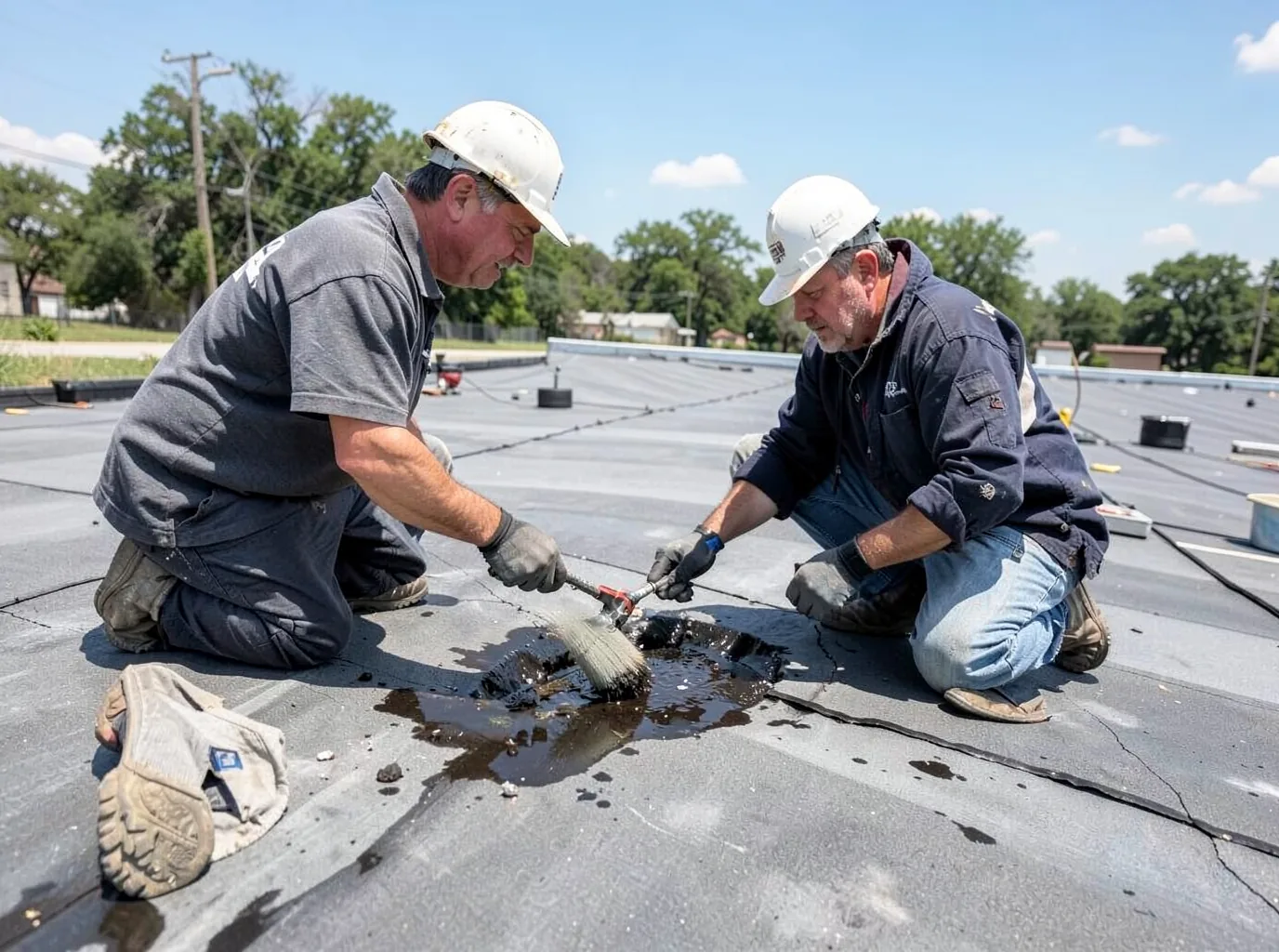
Commercial buildings in Abilene often feature flat or low-slope roofs that suffer from UV degradation during hot summers and thermal movement that cracks sealants around penetrations. In neighborhoods such as Northwest Abilene and near Dyess Air Force Base, these roofs see added stress from occasional heavy downpours after extended dry periods, allowing water to migrate under membranes before visible interior damage appears. Proper repair requires identifying the exact entry point rather than relying on surface patches that fail within one season.
Low annual rainfall in Taylor County means many commercial owners skip routine inspections until a leak is reported, at which point insulation and decking may already be compromised. Metal panel roofs common on industrial sites near South Abilene and Elmwood demand specific screw-seal and lap-seal techniques that differ from residential asphalt work. Ignoring these details leads to recurring leaks when mild winter temperature swings cause contraction around fasteners.
Work near landmarks such as the Grace Museum or Paramount Theatre requires coordination with downtown access restrictions and attention to historic building codes that limit certain adhesive products. Technicians must also account for drainage slopes that were never designed for the intense but infrequent storms that reach Abilene from the direction of San Angelo or Wichita Falls.
Edge cases include leaks at HVAC curbs where vibration loosens flashing and at parapet walls where wind-driven rain pushes water behind coping. These require removal of existing materials for inspection rather than cosmetic caulking that masks the problem until the next rainfall event.
Technician insight
In Abilene the thing that catches most people out with commercial roof leak repair is assuming that because rainfall is low the roof can go years without inspection; the real damage happens during the first hard rain after months of UV and heat cycling that opens seams around HVAC curbs on buildings near Dyess or in Sears Park.
Flat Roof Leak Near Dyess Air Force Base
Water was entering a storage facility ceiling after a sudden storm. Inspection showed failed lap sealant on a low-slope TPO roof where thermal expansion had pulled seams apart around two HVAC curbs. We removed the old tape, installed new reinforced flashing, and restored drainage slope at the scuppers. The owner reported no further intrusion after the next measurable rain.
Commercial Roof Leak Repair Services We Offer
✓Flat Roof Membrane Patching
Locate and repair punctures or seam failures in TPO, EPDM, and modified bitumen systems before water reaches insulation layers.
✓Metal Panel Leak Sealing
Replace degraded screws, apply butyl tape, and reseal laps on commercial metal roofs exposed to Abilene's temperature swings.
✓Drainage System Restoration
Clear scuppers, clean internal drains, and correct ponding areas that develop on low-slope roofs after long dry spells.
✓HVAC Curb and Penetration Flashing
Rebuild failed flashing around rooftop units where vibration and heat cycles create entry points for water.
✓Parapet Wall and Coping Repairs
Address water intrusion behind coping stones and parapets common on downtown Abilene commercial structures.
Commercial Roof Leak Repair Cost in Abilene, TX
| Service | Typical Range | What Affects It |
|---|---|---|
| Initial commercial leak inspection | $175–$350 | Higher when roof access requires lift or when multiple penetrations must be checked |
| Membrane or metal panel patch | $450–$1,200 | Depends on size of area and whether insulation replacement is required |
| Drainage clearing and repair | $300–$650 | Increases if internal piping must be accessed or if ponding correction involves re-sloping |
Ranges are typical for Abilene, TX and confirmed with an exact written quote before any work starts.
How it works
- 1
Site Assessment
Inspect the roof during daylight hours, map all penetrations, and use moisture scanning to locate hidden wet insulation without destructive testing.
- 2
Leak Source Isolation
Perform controlled water testing from the high side to trace the actual entry point rather than assuming the lowest interior stain is the origin.
- 3
Targeted Repair Execution
Remove compromised material back to sound substrate, install compatible patch materials, and restore positive drainage where needed.
- 4
Documentation and Follow-Up
Provide photos of the repair area and schedule a return visit after the next measurable rain to confirm the fix holds.
Pricing
Pricing varies by roof access, material type, and whether wet insulation must be removed.